
The colors
A number of genes are known to affect coat color in dogs.
They all interact and, in some cases, other genetic effects, often unknown, can also influence color and pattern.
Short hair or long hair, solid color, agouti, or bicolor coat, base color black, white, blue, isabella or liver ... there are many possible combinations, not to mention the smoke variants, and the infinite shades of grey, beige, red, blue.
Add to that a wide variety of iris colors, ranging from light grey to brown, including blue, gold, green, heterochromatic or particoloured eyes, small white booties and spots on the chest, the absence or presence of a mask, all these possibilities make each puppy a unique little being.
We have greatly simplified the presentation of the coats without going into genetic details so that you can have basic information to guide you in your choice.
Below you will find the 4 basic colours, as well as the 3 dress patterns.

Nous avons beaucoup simplifié la présentation des robes sans entrer dans les détails génétiques afin que vous puissiez avoir des informations de base pour vous guider dans votre choix.
Vous trouverez donc ci dessous les 4 couleurs de base, ainsi que les 3 patrons de robe.
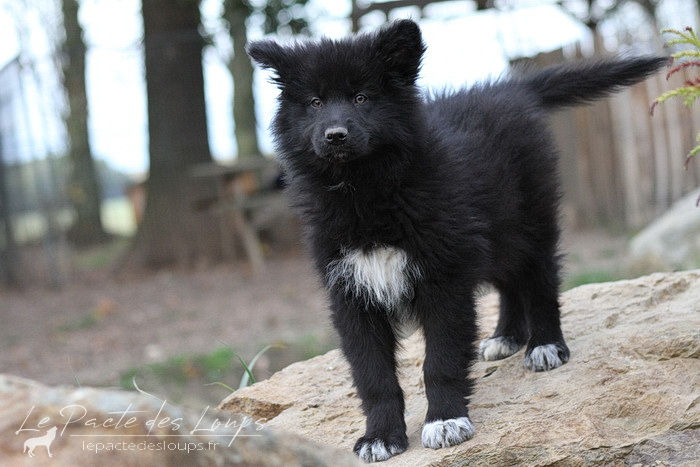
Black
From the clearest black to smoky black (with silver undercoat in more or less extensive areas).
There are sometimes red highlights, which can appear with or without silver smoke.




White
In this category we have grouped white, champagne, amber and fawn puppies.
The dog cannot produce dark hair and expresses a red pigment called pheomelanin over its entire body, the intensity of this pigment being more or less pronounced from pure white to fawn.
The mucous membranes are of different shades if the white masks another color.


Blue
The color is actually a more or less dark 'chartreux' gray ('powder blue' or 'steele blue'), almost always associated with smoke for single-colored dresses.
The puppy can be solid blue, sand blue, bi-color blue (silver base, cream, tan), the blue in agouti coats can be very discreet.
The mucous membranes are gray.
Although the blue dilution gene is the source of a hereditary health problem in some breeds (canine dilution alopecia), we have carefully selected our breeding stock so that this does not affect our bloodlines.


Liver
The color is a more or less pronounced red depending on the pattern of the coat.
The puppy can be solid liver, sable liver, bicolor liver, with or without smoke.
The mucous membranes are liver-colored.


Isabelle
It is a very rare color, a mix of red and blue. Some puppies are more blue in color, while others are more red.
They can be solid isabelle, sable, two-tone.
The mucous membranes are more of a pinkish tint, tending more towards gray or liver depending on the puppy.


Solid
This group features puppies with a solid color coat.
The presence of smoke may make the puppy appear agouti, but genetically the puppy is solid.
White markings on a dog can also make people think it is bicolor even if it is not.


Agouti
This group features puppies with a coat that has bands of different colors on the same hair.
It is also called Wolf Sable or sable in Anglo-Saxon countries, the term sable actually referring to the coat pattern and not the color itself. They tend to darken with age.
Sand blue, liver sand and isabella sand are illustrated in their own color group.


Bi-color
This category also includes the two-tone blue, liver and isabella, but we have chosen to present them to you in their color category.
The puppy has markings on the head and legs that are lighter than the back, which is therefore black, blue, liver or isabella (the color of the back can be associated with smoke markings, which can resemble a sand pattern coat).
Two-tone dresses lighten over time.


